
Health Infrastructure Pulse
where healthcare infrastructure meets the climate imperative

Week of April 26, 2026 • Issue No. 7
This week’s strongest signal: hospitals are entering an era where infrastructure strategy matters as much as clinical strategy. Grid capacity, electrification, microgrids, project finance, procurement models, and aging-estate risk are converging. The question is no longer whether hospitals need better infrastructure—it is whether they can design, finance, and govern it fast enough.
From the Field
What I’ll Be Talking About on May 12
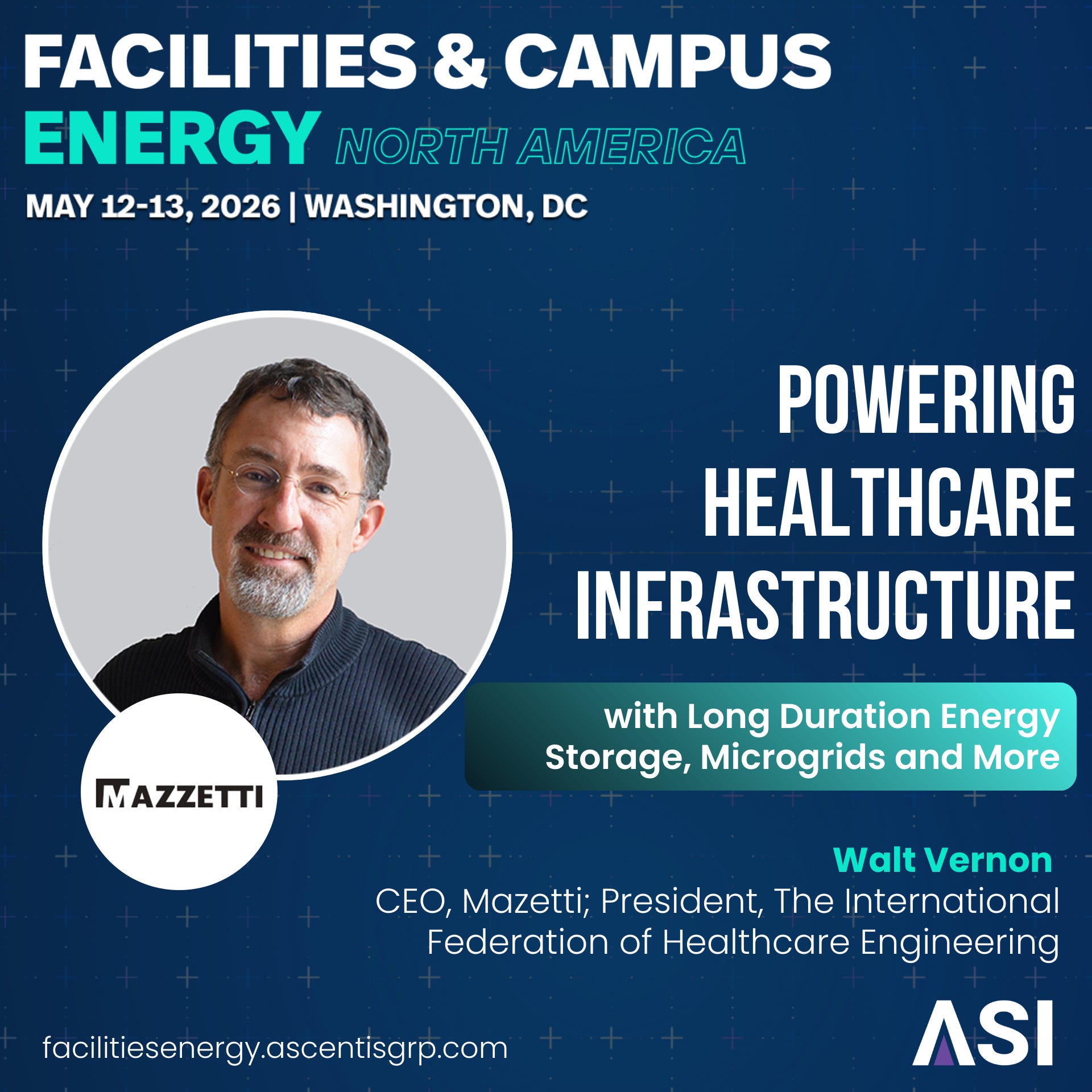
Next week, I will be speaking at the Facilities and Campus Energy Summit in Washington, DC.
Other speakers, by the way, include a large number of friends and colleagues – Mike Chihoski, VP, UCHealth; Steve Carberry, former VP Yale New Haven, Brian Weldy, former VP HCA Healthcare, and many many more.
I will be speaking from the perspective that design of healthcare energy infrastructure is no longer simply a technical exercise. Today, designing healthcare energy infrastructure – and doing it right - involves designing the technology systems, sure, but also, and often more important, the project finance systems, the resulting energy procurement systems, and the network of legal and regulatory systems that together, make the project work.
The macro pressures around us are moving much faster than our mental models, and it is time for us to understand those forces, and take advantage of changes that are opening before us.
In particular, the NFPA codes have been moving in recent years away from the antiquated notion that an infinite, reliable, inexpensive utility will be there most of the time, and that we just need to invest in an expensive insurance policy called a diesel generator for times when that utility fails. Today, an array of on-site energy systems can provide power to both sides of the transfer switch, giving us possibilities for radically different kinds of designs.
And, just in the nick of time. With the increasing rollout of building performance standards, all-electric codes, air quality management regulations, and similar legal pressures, healthcare buildings need this kind of flexibility. And with increasing loads on the electrical grid making that grid no longer infinite, reliable, and inexpensive, healthcare facilities need new solutions that take advantage of rapidly changing rate structures that will be increasingly coming down the pike.
I will talk a bit about what is happening in the NFPA codes that will help us. I will talk about a proposed new chapter for the International Green Construction Code on low-carbon on-site energy resilience systems, and the opportunities this will create. I will also discuss a new initiative I am working on to bring together a number of organizations including ASHRAE, The Joint Commission, and others to create an integrated standard for behind the meter energy resilience standard.
I recently submitted a paper to the National Academy of Medicine on how to finance Healthcare Decarbonization, together with Eric Berzon, retired Vice President and Assistant Treasurer at Kaiser Permanente, Robyn Helmlinger, Partner of Orrick, and Kate Sherwood, CEO of ZeroEnergy, and I will touch on some of these opportunities.
There is a lot of pressure on healthcare energy systems these days. Most healthcare owners tell me their priorities are resilience and cost, in that order. And, if they can get it, low carbon. Now, with emerging opportunities to integrate new technologies, new regulatory developments, new energy procurement strategies, and new project finance structures, we can do it all.
I hope to see you there!
Details: facilitiesenergy.ascentisgrp.com
— Walt Vernon
IFHE Global Scan
English-Speaking Americas
Key Signals
ERCOT demand forecast: a warning for every high-growth region. 367,790 MW projected demand by 2032 vs. 85,508 MW peak in 2023. 410 GW of large-load interconnection requests, 87% data centers. FERC intends to act by June. NERC launched Project 2026-02 for computational load reliability standards. Hospitals will compete with data centers for grid capacity. ERCOT forecast
Kaiser Permanente proposes all-electric replacement hospital in San Francisco. 300-bed, 623,000 sf, 14-story, all-electric. Replaces 1954 Geary campus. Construction 2028, completion 2033. Kaiser’s third all-electric hospital after Sacramento and San Jose. Connects seismic replacement, urban land use, electrification, and California decarbonization strategy. SF Chronicle / SFist
Reid Health: 3.75MW Tier 4 microgrid saving $625K/year. EPA Tier 4 certified PowerSecure microgrid guaranteeing 100% standby power through 160 hours of strategic peak operation. Resilience first, then ROI. A microgrid is not a backup system—it is an active financial asset. PowerSecure case study
DOE backs Montezuma County Hospital BESS. Federal support for microgrid controller + battery capable of islanding entire campus load at a rural Colorado hospital. A signal that BESS is taken seriously beyond academic medical centers. DOE project page
FERC demand response / aggregator rules on April agenda. Revisiting the DR opt-out framework. Hospitals wanting to participate in aggregated demand response live downstream of these governance choices. Perkins Coie analysis
California Load Management Standards: implementation reports filed. CEC Docket 23-LMS-01. Signal-responsive load shifting becoming operational—exactly what hospitals need as electrification grows. CEC docket log
ASHRAE/ASHE Guideline 43: ventilation as managed program. Companion to 170-2025. Shifts from “meet the spec at turnover” to “demonstrate ongoing performance.” Affects commissioning, monitoring, and maintenance staffing. ASHRAE
Essential vs. non-essential / on-site vs. off-site: NEC terminology shift. From 2026, NEC framing moves to Essential Electrical System vs. non-essential, on-site vs. off-site sources. On-site can be used “anytime”—enabling demand response and peak shaving, not just backup. IAEI Magazine
Construction & Capital Projects
JPS Health Network (Fort Worth, TX): $1.5B, 1.1M sf hospital within a $2.5B master facility plan. Completion 2030. KERA / Fort Worth Report
HCA Florida Ocala: $200M expansion—seven-story tower, 62 private rooms, new central utility plant. Ocala-News
WVU Medicine: $350M+ in 2026 capital across WV, MD, OH. Three-year total exceeds $1.2B. WVU Medicine
HSHS Green Bay: $270M overall; $17.2M NICU at St. Vincent Children’s. Private room conversion. The Business News
Catholic Medical Center (Manchester, NH): $27M infrastructure modernization (electrical, HVAC, elevators, fire safety). The “unsexy but decisive” category. CMC
Samaritan Healthcare (Moses Lake, WA): $225M replacement hospital, 174,000 sf, three-story. Rural replacement remains a sustained construction category. Terrapin CG
Gundersen/Bellin (Emplify Health) + Xcel Energy (WI): All-renewable microgrid with islanding, expected complete 2026. Battery + solar + landfill gas. Gundersen Health
Outpatient now 40%+ of U.S. healthcare construction. Ambulatory surgery centers and cancer hubs dominating capital, shifting investment from centralized mega-campuses. Roche Constructors analysis
Project Finance & Energy Procurement
HFMA: 41% of systems cutting capital; AI is #1 priority. ROI now the critical factor for 77% of purchasing decisions (up from 50%). Growth projects lead; infrastructure competes. For energy projects, this means EaaS, C-PACE, and off-balance-sheet structures are not optional—they are the only path to deployment for most systems. HFMA Fast Finance
C-PACE now available in 30+ states for healthcare. Commercial Property Assessed Clean Energy financing enables hospitals to fund energy efficiency, resilience, and renewable energy improvements through property tax assessments—no upfront capital, no competition with clinical priorities. A key tool for addressing deferred infrastructure maintenance. SitelogIQ C-PACE guide
IRA direct pay for non-profit hospitals. The Inflation Reduction Act’s elective pay provisions allow tax-exempt hospitals to receive direct payment for clean energy tax credits (ITC, PTC) that were previously available only to for-profit entities. This fundamentally changes the economics of solar, storage, and microgrid deployment for non-profit health systems. IRS / Treasury
Solar PPA pricing: $28–42/MWh through 2027. BloombergNEF projects U.S. solar PPA prices will remain in the $28–42/MWh range. VPPAs offer non-profit hospitals financial settlement without physical delivery. Multi-buyer aggregated PPAs (like the Energize pharma/healthcare cohort) are reducing procurement costs and risk for institutional buyers. BloombergNEF / Sustainability Atlas
Canada
Ontario healthcare pipeline: 25 projects in pre-procurement or active procurement, combined estimated value exceeding C$30B. Infrastructure Ontario
South Niagara Hospital: 1.3M sf, structural work expected complete April 2026. Major scale and regional transformation. South Niagara Hospital
Peel Memorial Phase 2: Progressive contracting model—early engagement, risk management. Bird Construction
Caribbean
Grenada Project Polaris: Broke ground late March 2026. New general hospital with Mount Sinai partnership, replacing St. George’s General Hospital. Completion 2029. One of the Eastern Caribbean’s most significant healthcare projects. Government of Grenada
Sint Maarten Medical Center: Government intervened to ensure labor permits and financial oversight for island’s largest infrastructure project amid supply chain and cost inflation. Soualiga Newsday
Spanish-Speaking Americas
Key Signals & Projects
Peru: $3.3B healthcare PPP portfolio. PROINVERSIÓN 2026 pipeline includes New Central Military Hospital ($751M, 30-year concession). Puno hospital modernization signed under France G2G (296 beds, 7 ORs). Piura/Trujillo high-complexity hospitals by 2028. Andina / PROINVERSIÓN
Brazil: smart public hospital + IDB guarantee. First smart public hospital linked to SUS (2026–2029). IDB approved first guarantee for a hospital PPP in Mato Grosso do Sul—multilaterals using guarantee structures to support hospital PPPs. BNamericas
Colombia: Hospital San Juan de Dios revival. $430M (1.6 trillion pesos) to revive Bogotá’s historic hospital complex after 20+ years of closure. 24 buildings, 16 hectares. Restoring legacy healthcare assets, not just building new. Reuters / Colombia
Colombia-Netherlands fossil fuel transition summit. Santa Marta, April 24–29. Not healthcare-specific but may influence regional energy policy affecting hospital costs and renewables. Government of Colombia
Europe
Key Signals
Glasgow QEUH: £50M+ spent on construction remediation. Water and ventilation problems at Queen Elizabeth University Hospital, excluding public inquiry costs. Cautionary case on design quality, infection risk, commissioning, accountability, and lifecycle cost. BBC Scotland
EU Horizon Europe 2026: climate-resilient healthcare. Health calls include carbon-neutral and climate-resilient healthcare systems as funded research topics. Decarbonization entering EU research/policy mainstream. European Commission
Healthcare Estates 2026 (Manchester, Oct. 13–14). IHEEM theme: “Mind the Gap: Are We Heading for a Two-Tier Estate?” Net Zero Innovation and Sustainable Achievement awards. IHEEM
NHS Scunthorpe goes geothermal. CeraPhi Energy awarded contract to deliver geothermal heating via repurposed 550m borehole, integrated into new energy centre and heat network. ThinkGeoEnergy
FKT promoting IFHE. FKT posted item pointing German healthcare engineers to IFHE. Active 2026 program: digital infrastructure, Gelsenkirchen conference (Sept. 30–Oct. 1), innovation prize (due July 31). FKT
ZORG.tech Congress (Belgium, June 4–5). Continuing Belgian/European healthcare technology convening. ZORG.tech
EU refrigerant cliff hits hospital chillers. Accelerated F-gas phase-out impacting hospital chiller procurement starting late 2026. Natural refrigerant transition (ammonia, CO₂, propane) requires new safety protocols and mechanical room ventilation. European Commission F-gas
Prefabrication as baseline: global shift. MEP racking, bathrooms, and modular headwalls officially standard for major contractors. Engineers must finalize equipment specs months earlier. ASHE / HFM survey
Africa
Key Signals & Projects
Côte d’Ivoire: €241M UKEF for 6 new hospitals. UK Export Finance backing design, construction, and equipping in Bouaké, Boundiali, Katiola, Kouto, Minignan, and Ouangolodougou. Export credit agencies remain vital for Francophone Africa healthcare. GOV.UK
Nigeria: N27.3 trillion pension debate for hospital PPPs. Legislative debate to unlock institutional pension assets for “Health Infrastructure Bonds” with AfDB first-loss guarantees. If realized, a transformative financing mechanism. Pension Policy International
Nigeria NERC Mini-Grid Regulations 2026. Framework covering up to 5 MW isolated, 10 MW interconnected. Clearer permitting for health facility PV + battery systems. BusinessDay Nigeria
Ghana: 2026 budget hospital program. 6 new regional hospitals, 10 Agenda 111 completions, 4 resumed abandoned projects. Tamale Teaching Hospital cardiology centre under construction. GhanaWeb
Burundi: UNDP solar health facility rollout. Phase 2 commissioning 9 hospitals in April 2026 (45 kWp PV, 115 kWh BESS per site, 12–25 hours backup). Covers ~20% of district hospitals nationwide. UNDP
SAFHE 2026 (Cape Town, June 9–10). Theme: “Synergy in Action: Shaping the Future of Healthcare Together.” Engineers, architects, clinicians, infection specialists, facility managers. SAFHE
Asia / Pacific
Key Signals & Projects
Queensland Coomera Hospital (Australia): A$2.55B, 600-bed staged delivery (400 beds by 2031, 200 by 2032). Emergency, ICU, OR, maternity, mental health, oncology, ambulatory. Queensland Government
Sydney Adventist Hospital (Australia): $690M Wahroonga Estate campus redevelopment. New hospital facilities, residential towers, campus transformation. Sydney Adventist Hospital
Mount Barker Hospital (SA, Australia): $365.8M redevelopment, tripling inpatient capacity from 34 to 102 beds. SA Health
Victoria New Melton Hospital (Australia): 274-bed new hospital, 700+ direct construction jobs. Victorian Government
Singapore Mount Elizabeth: S$350M Project Renaissance completed—first major campus overhaul since 1979. AI-enabled systems, complex-care capacity, digital innovation. Mount Elizabeth Hospital
Singapore: new eastern private hospital land release. First new private hospital site in nearly 20 years. Singapore using infrastructure planning, design standards, and capacity expansion together. Singapore MOH
Singapore Healthcare Facility Design Standards. Faster, more consistent, technology-enabled delivery. Links construction standardization, smart design, and digital infrastructure. Singapore MOH
India Victoria Hospital Q-block (Bengaluru): 10-storey, 629-bed addition opening May 2, 2026. General wards, OR complex, helipad. Indian Express
India NewEra Hospitals (Nagpur): Premji Invest-backed expansion from 350 to 800 beds. Three new hospitals. Quaternary care outside major metros. Economic Times
Hong Kong hospital expansion: 20-storey block adding ~1,500 beds. Drone-enabled construction monitoring on live healthcare campus. Leighton Asia
JCI 8th Edition: sustainability in accreditation. Effective Jan. 1, 2025. Includes Global Health Impact chapter. JCI Sustainable Healthcare Certification available to non-accredited organizations outside U.S. JCI
IFHE Global Connection
LDES for Healthcare Summit: National Labs secured. Agreement with U.S. National Laboratories to present at July 13 one-day symposium in Salt Lake City. LDES moving from grid strategy into facility-level planning. Email the author for information. LDES Consortium
IFHE 2026 Congress registration live. 29th IFHE World Congress, October 17–20, New Orleans, co-located with HCD Conference + Expo. Register here
Subscribe to the IFHE Newsletter: ifhe.info/newsletter
Signal Bank
Parked for future issues.
All-Electric Hospitals: Peace Island Medical Center record correction (standalone piece). Kaiser Sunnyside, Kaiser Ontario, Kaiser SF proposed. Trend tracking.
Water-Energy Nexus: Mexico City greywater mandates. South Africa ESG water disclosures. California 72–96 hour requirement. ASHRAE 189.3 water resilience task force (author leading).
Refrigerant & Thermal: ASHRAE 170 decoupling debate. UAE AI-dynamic tariffs. India solar absorption chillers.
Climate, Finance & Hedging: NAM financing paper. California insurance +41–88% by 2035. VCH Phase 2 unfunded. Direct Relief Florida microgrids. Carbon market AB 1911. CARB cap-and-invest (May 28).
Grid-Interactive: California V2G fleet pilots. Data centers as grid assets. California regulators vs. data center diesel. Large-load tariff proliferation. Maine data center ban.
Smart Hospitals & Cybersecurity: NFPA 99 cybersecurity. Circularity / medical equipment lifecycle (ASHRAE/UCOP). QMS digital patient tracers for JCI.
Calendar & What to Watch
May 4–7: IEEE PES T&D, Chicago. ieee-pes.org
May 6–7: IHEEM Wales Conference, ICC Newport. iheem.org.uk
May 12–13: Facilities & Campus Energy Summit, DC — Walt Vernon speaking May 12, 2:10 PM. facilitiesenergy.ascentisgrp.com
May 13: IFHE Webinar: Geothermal Heating & Cooling for Hospitals. ifhe.info
May 19: FKT: Li-ion battery safety in healthcare. fkt.de
June 4–5: ZORG.tech Congress, Brussels Gate, Belgium. zorgtech.be
June 9–10: SAFHE 2026, Cape Town. safhe.co.za
July 13: LDES in Healthcare Symposium, Salt Lake City — National Labs presenting. Email the author.
July 14–15: U.S. LDES Consortium Annual Meeting, Salt Lake City. ldesconsortium.sandia.gov
Sept. 30–Oct. 1: FKT Conference, Gelsenkirchen. Innovation prize apps due July 31. fkt.de
Oct. 13–14: IHEEM Healthcare Estates, Manchester. iheem.org.uk
Oct. 17–20: 29th IFHE World Congress + HCD, New Orleans. Register: hcdexpo.com
About the Author
Walt Vernon holds degrees in electrical engineering, business, law, and energy law. He is President of the International Federation of Healthcare Engineering, CEO and principal at Mazzetti—an employee-owned benefit corporation working to bend the climate curve—and founder of the Sextant Foundation, an NGO advancing clean energy systems for low-resourced health facilities worldwide. He helped write portions of the National Electric Code that opened the door to hospital microgrid systems, serves on the ASHRAE 189.3 committee and the ASHE Battery Safety Task Group, and is a member of the leadership team of the U.S. National Consortium on Long Duration Energy Storage.
Working at the intersection of technology, energy, climate law and regulation, energy procurement, and project finance.